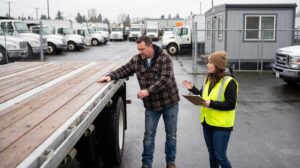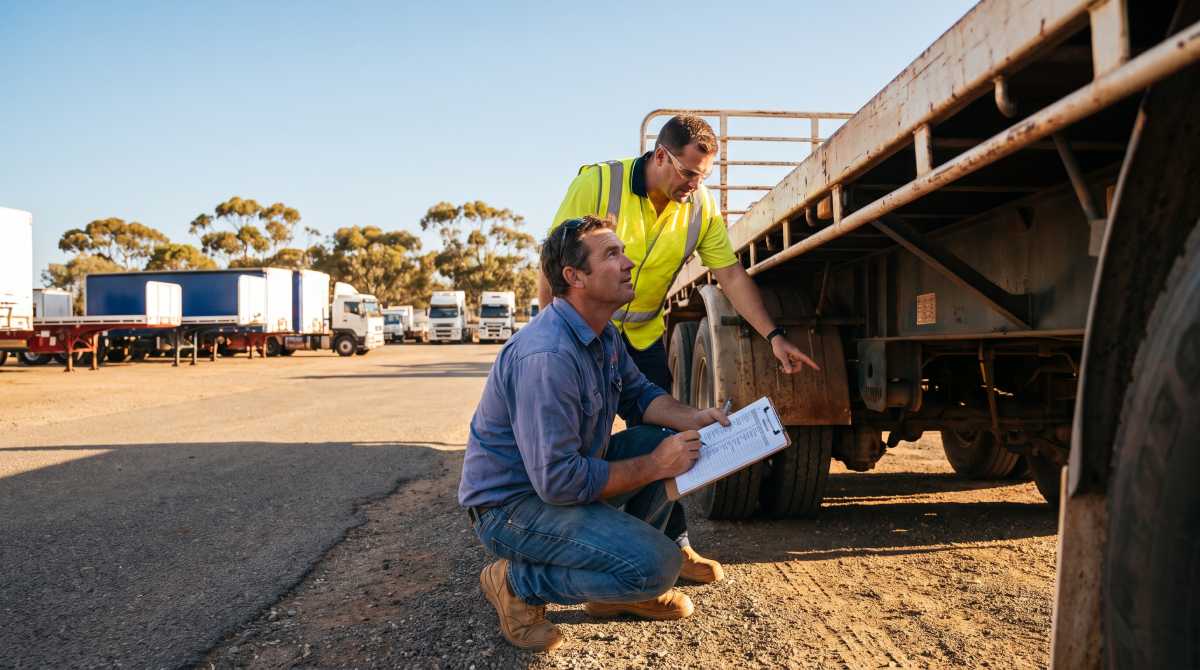
Buying a truck trailer is not like buying a car. The stakes are higher. The specifications are more complex. The compliance requirements are stricter. And a mistake does not just cost you money on the day. It costs you money on every trip, through lost payload, excess fuel consumption, unplanned repairs, and reduced resale value, for years afterward.
Western Australia makes the decision even more consequential because the conditions here push equipment harder than anywhere else in the country. Trailers that perform adequately in the mild climate and smooth highways of the eastern seaboard may deteriorate rapidly under the extreme heat, abrasive dust, corrugated unsealed roads, and punishing distances of WA operations. A trailer that looks solid in the yard can reveal cracked chassis rails, fatigued suspension, shot brakes, and corroded wiring within months of entering service in the Pilbara, the Goldfields, or even the agricultural corridors of the Wheatbelt.
This guide provides a structured, item-by-item checklist that every WA operator should work through before committing to any truck trailer purchase. It covers the pre-inspection research, the physical inspection, the compliance and documentation checks, the financial evaluation, and the final steps that separate a confident purchase from an expensive gamble.
Before You Inspect: The Research Phase
The most important work happens before you ever lay eyes on the trailer. Walking onto a yard without having done your homework puts you at a disadvantage. You do not know what a fair price looks like. You do not know what specification suits your operation. And you do not know what questions to ask.
Define Your Requirements First
Before searching for a truck trailer for sale anywhere in WA, lock down your operational requirements. Everything else flows from these answers.
- What will you carry? The cargo type determines the trailer type. Flat tops for general freight. Drop decks for equipment. Tippers for bulk materials. Curtainsiders for palletised goods.
- How heavy is your typical load? This determines the axle configuration and GVM rating you need.
- What routes will you run? The mass limits, road conditions, and distances on your intended routes affect the specification requirements.
- What prime mover will pull it? The trailer must be compatible with your truck’s fifth wheel, GCM rating, and braking system.
- New, used, or hire? Your budget, utilisation rate, and holding period determine which approach delivers the best return.
If you are unsure which trailer type matches your business, the guide to matching the right trailer to your operation walks through the decision framework in detail.
Research the Market and Pricing
Understanding what trailers cost before you start inspecting prevents you from overpaying or, equally dangerous, being attracted to a suspiciously cheap unit that is cheap for a reason.
| Trailer Type | New Price Range (2026) | Used Price Range | Key Cost Variables |
| Flat top (triaxle) | $65,000-$100,000+ | $22,000-$70,000 | Deck material, suspension, gates, container pins |
| Drop deck (triaxle) | $90,000-$180,000+ | $40,000-$120,000 | Ramp type, widening capability, winch, deck height |
| Side tipper (triaxle) | $100,000-$200,000+ | $50,000-$130,000 | Body material, hydraulics, road train plumbing |
| End tipper (triaxle) | $80,000-$160,000 | $35,000-$100,000 | Body volume, tipping mechanism, liner material |
| Curtainsider (triaxle) | $90,000-$160,000 | $30,000-$90,000 | Curtain quality, mezzanine floor, load restraint system |
| Low loader (quad axle) | $150,000-$300,000+ | $60,000-$180,000 | Deck height, axle configuration, hydraulic gooseneck |
For a comprehensive breakdown of what drives pricing across each category, the complete guide to truck trailer costs in Australia provides the benchmarks you need.
Check Whether Hiring Makes More Sense
Not every requirement justifies a purchase. If the work is short-term, seasonal, or uncertain, hiring may deliver better value than buying. Run the numbers before committing capital. The breakeven between hiring and buying typically sits at 8 to 10 months of continuous use per year. Below that threshold, hiring usually wins.
The Physical Inspection Checklist
This is the core of your pre-purchase evaluation. Work through every section systematically. Do not skip areas because the trailer looks good from a distance. The most expensive defects are the ones hidden underneath.
Chassis and Structural Integrity
The chassis is the skeleton of the trailer. Everything else bolts to it. If the chassis is compromised, the trailer is compromised.
What to inspect:
- Walk the full length of both main rails, checking for cracking, bending, or evidence of welded repairs
- Examine the crossmembers for cracking at the welds where they join the main rails
- Check around the king pin mounting plate for cracks, distortion, or excessive wear
- Inspect the axle mounting points for cracking, elongated bolt holes, or movement
- Look for rust or corrosion, particularly on the underside and in areas where mud and debris accumulate
- Check that the chassis is straight by sighting along the main rails from front to rear
Red flags:
- Cracking at any welded joint, particularly at high-stress points around axle mounts and the coupling area
- Evidence of straightening or re-railing, which indicates previous structural damage
- Heavy corrosion that has reduced the thickness of the steel
- Misalignment between the king pin and the rear axle group
Suspension System
The suspension determines how the trailer rides, how it handles under load, and how well it protects both the cargo and the road surface.
| Component | What to Check | Acceptable Condition | Replace If |
| Airbags (if fitted) | Visible cracking, leaks, uneven height | Uniform height, no visible cracks | Cracked, leaking, or unable to hold pressure |
| Springs (if fitted) | Broken leaves, sagging, misalignment | All leaves intact, even stance | Broken leaves, heavy sagging |
| Shock absorbers | Leaking, loose mounting, bounce test | Firm resistance, dry body | Leaking oil, soft or no resistance |
| Bushings | Cracking, play, deterioration | Firm with no excessive movement | Cracked, perished, or loose |
| Equaliser beams | Cracking, wear at pivot points | No cracking, pivot moves freely | Cracked or seized |
| Ride height | Measure unloaded height at each axle | Consistent across all axles | Variance greater than 15mm between sides |
For trailers intended for WA’s harsh conditions, airbag suspension is strongly preferred. It provides better load protection, qualifies for concessional mass schemes, and allows deck height adjustment. Mechanical spring suspension is acceptable for heavy-duty mining and construction applications where robustness outweighs ride quality.
Braking System
Brakes are a safety-critical system. A trailer with worn brakes is not just a maintenance issue. It is a compliance breach and a liability exposure.
Inspection points:
- Measure brake pad or shoe thickness. Minimum legal thickness varies but is typically 3 to 4mm. Replace if approaching minimum.
- Inspect brake drums or discs for scoring, cracking, heat discolouration, or lip wear
- Check all air lines and fittings for cracks, chafing, and leaks. Charge the system and listen for air escaping.
- Test the park brake and ensure it holds the trailer on a gradient
- Check the ABS or EBS sensors and wiring for damage
- Inspect the slack adjusters for correct operation and excessive free play
- Verify that the emergency brake system functions correctly
A trailer with marginal brakes can be negotiated down in price to cover the cost of a reline, but a trailer with cracked drums, corroded airlines, or a non-functional ABS system needs significantly more work and should be priced accordingly.
Tyres and Wheels
Tyres are one of the largest consumable costs on any trailer, and their condition at purchase directly affects your first-year operating costs.
- Check tread depth across all positions. Legal minimum is 1.5mm but operational minimum should be 4mm or more for WA conditions.
- Inspect for uneven wear patterns, which indicate alignment, suspension, or loading problems
- Check tyre age by reading the DOT code. Tyres older than five years should be treated with caution regardless of remaining tread.
- Inspect wheel rims for cracks, dents, and elongated stud holes
- Check all wheel nuts for correct torque and evidence of movement
- Verify that the tyre size and load rating match the trailer’s specifications
A full set of tyres on a triaxle trailer costs $3,000 to $6,000. Factor this into your price negotiation if the tyres are near the end of their life.
Deck, Body, and Superstructure
The condition of the deck or body depends on the trailer type, but the principles are consistent.
For flat tops and flat decks:
- Check the deck surface for excessive wear, warping, or rot (timber decks)
- Inspect all tie-down points for damage, corrosion, or pull-out
- Check gate hinges, latches, and headboard connections
- Verify that container pins (if fitted) lock and release correctly
- Inspect coaming rails for bending, cracking, or weld failure
A flat deck trailer in good condition should have a flat, true deck surface, solid tie-down points, and functional gates.
For drop decks:
- Check ramp hinges, hydraulic cylinders, and locking mechanisms
- Inspect the step between upper and lower decks for cracking
- Verify the beavertail section is not bent or damaged
- Test the widening mechanism if the trailer is a widener
The drop deck buying guide covers these inspection points in greater detail. For an example of premium drop deck specification, the Freightwest next-generation triaxle dropdeck widener shows what a top-specification unit looks like.
For tippers:
- Inspect the body for dents, cracks, and weld repairs
- Test the hydraulic system through a full tip cycle
- Check for hydraulic leaks at rams, hoses, and fittings
- Inspect the tailgate or discharge mechanism for wear and correct operation
- Check the body liner (if fitted) for excessive wear
The side tipper selection guide covers the specific considerations for WA tipper operations.
Electrical System
The electrical system covers all lighting, ABS/EBS wiring, and any electronically controlled systems on the trailer.
- Test all lights: tail, brake, indicators, reverse, clearance, and number plate
- Check the trailer plug and socket for corrosion, damaged pins, and loose connections
- Inspect the wiring harness for chafing, rodent damage, and incorrect splicing
- Verify that ABS/EBS warning lights function correctly when the trailer is connected to the prime mover
- Check for water ingress in junction boxes and light housings
Electrical problems are common on older trailers and can be time-consuming to diagnose and repair. Budget $500 to $2,000 for a full electrical overhaul if the system shows signs of deterioration.
Coupling and Landing Gear
- Inspect the king pin for wear, scoring, and correct dimension (2-inch or 3.5-inch)
- Check the king pin mounting plate for cracking around the bolt pattern
- Test the landing legs through their full range of operation
- Check the landing leg pads for wear and the gearbox for smooth operation
- Verify that road train coupling hardware (if fitted) is in serviceable condition
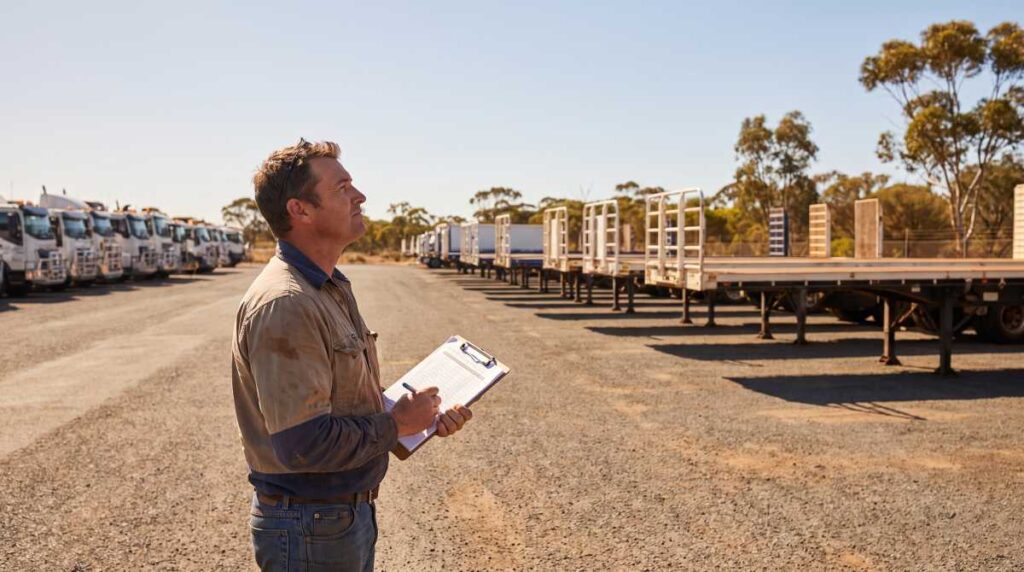
The Documentation and Compliance Checklist
A trailer that passes the physical inspection but fails the paperwork check is a trailer you cannot legally operate.
Essential Documents to Verify
| Document | What It Confirms | Where to Check |
| Registration | The trailer is currently registered and fees are paid | WA Department of Transport |
| VIN verification | The chassis number matches the registration documents | Physical inspection of VIN plate |
| Compliance plate | The trailer meets Australian Design Rules | Attached to the chassis near the king pin |
| PPSR search | No finance owing, no security interests registered | Personal Property Securities Register online |
| Service history | Maintenance has been performed regularly | Seller’s records, service provider records |
| Modification certification | Any structural modifications have been engineered and certified | Engineering certificates from a qualified engineer |
| Roadworthy inspection | The trailer meets roadworthiness standards | Recent inspection report or certificate |
The PPSR Search
This is non-negotiable. The Personal Property Securities Register search confirms whether any finance, security interest, or encumbrance is registered against the trailer. If you buy a trailer with money owing on it, the financier can repossess it regardless of whether you paid the seller in good faith. The search costs approximately $3.40 per item and takes minutes. There is no excuse for skipping it.
Modification Compliance
Any modification to the trailer’s structure, axle configuration, body, or coupling arrangement must be certified by a qualified engineer and documented. Common modifications that require certification include axle additions or changes, chassis extensions or modifications, coupling type changes, and body replacements or significant structural repairs.
A modification without certification creates a compliance risk that can result in defect notices, failed roadworthiness inspections, and insurance complications.
The Financial Evaluation Checklist
The purchase price is just the starting point. Your financial evaluation should consider the total cost of putting the trailer into service and keeping it there.
Pre-Service Cost Estimation
After your inspection, list every item that needs attention before the trailer can work. Then get quotes.
- Tyres: $500-$1,000 per tyre, 6 to 12 tyres depending on axle configuration
- Brake reline: $1,500-$3,500 for a full reline including drums if scored
- Suspension overhaul: $2,000-$5,000 depending on the components needed
- Electrical rewire: $500-$2,000 for a partial or full rewire
- Deck repairs: $500-$3,000 depending on extent and material
- Hydraulic rebuild (tippers): $2,000-$6,000 for cylinder, hose, and pump servicing
- Registration transfer: Fees vary by state
- Paint and presentation: $1,000-$4,000 if the trailer needs repainting
Add these costs to the purchase price to calculate the true acquisition cost. This is the number you compare against the cost of a newer or new unit.
Total Cost of Ownership Model
| Cost Element | Annual Estimate (Triaxle) | Notes |
| Finance/depreciation | $5,000-$18,000 | Depends on purchase price and finance terms |
| Registration | $1,500-$3,000 | Based on GVM and axle configuration |
| Insurance | $2,000-$5,000 | Based on value, application, and claims history |
| Maintenance | $3,000-$10,000 | Higher for older trailers in demanding applications |
| Tyres | $3,000-$6,000 | Varies with road conditions and loading |
| Total annual carrying cost | $14,500-$42,000 | Before any revenue is earned |
Compare this against the revenue the trailer will generate. If the annual carrying cost represents more than 15 to 20 per cent of the trailer’s expected annual revenue, the economics are tight and the margin for error is small.
Finance Considerations
If you are financing the purchase, have conditional approval in place before you commit. Common structures include chattel mortgage, which provides ownership from day one, finance lease, which preserves capital, and hire purchase with an end-of-term buyout option. The $20,000 instant asset write-off applies to eligible small businesses with turnover under $10 million, though most trailer purchases exceed this threshold. Engage your accountant before committing to a finance structure.
The WA-Specific Checklist
Western Australian conditions demand additional scrutiny that buyers in other states may not consider.
Heat Tolerance
- Confirm the tyre load and speed ratings are appropriate for sustained operation in temperatures above 40 degrees
- Check that hydraulic fluid (on tippers) is rated for high-temperature operation
- Verify that brake components are rated for the heat generated during sustained descents on WA’s hilly regional routes
- Inspect all rubber components (airbags, hoses, seals, bushings) for heat-related deterioration
Dust and Corrosion Resistance
- Check that wheel bearings are sealed adequately for dusty conditions
- Inspect brake drums and components for dust contamination
- Look for corrosion on fasteners, wiring terminals, and air fittings, particularly if the trailer has operated in coastal areas
- Verify that air system filters and dryers are present and functional
Remote Area Preparedness
- Assess whether common spare parts for the trailer are readily available in WA
- Consider carrying critical spares (air fittings, brake components, globes) if the trailer will operate in remote areas
- Confirm that the trailer’s brand and model have adequate service support in Perth and your regional operating area
The Final Decision Framework
You have completed your research. You have inspected the trailer. You have verified the documents. You have modelled the finances. Now bring it all together.
Go/No-Go Decision Matrix
- Go if the chassis is sound with no cracking or structural concerns, the mechanical components are serviceable or the cost to bring them up to standard is reflected in the price, the documentation is complete and clean, the total acquisition cost (purchase plus remediation) represents fair value for the trailer’s age and condition, and the trailer matches your operational requirements.
- Negotiate if the trailer needs tyres, brakes, or other consumable replacements but is otherwise sound. Deduct the cost of these items from the asking price.
- Walk away if there is chassis cracking at structural points, if the documentation is incomplete or suspicious, if the PPSR search reveals encumbrances, if the total remediation cost pushes the acquisition price above the value of a comparable unit in better condition, or if the seller cannot explain gaps in the service history.
For operators ready to browse what is available across all categories, the current stocklist provides an up-to-date view of trailers in stock. And for a broader overview of all trailer types, the complete trailer range covers flat tops, drop decks, tippers, tankers, and specialised configurations.
For any remaining questions about trailer specifications, compatibility, or compliance, the truck trailer FAQ guide addresses the most common queries that buyers have during the evaluation process.
Frequently Asked Questions
What is the most important thing to check when buying a used truck trailer?
The chassis. Everything else on a trailer can be repaired or replaced at a known cost. But a chassis with structural cracking, fatigue damage, or evidence of prior accident repair represents a fundamental integrity issue that may make the trailer uneconomical to repair or unsafe to operate. Walk both main rails, inspect every weld point around the axle mounts and coupling area, and sight along the chassis for straightness. If you are not confident assessing structural integrity yourself, engage a qualified heavy vehicle mechanic to inspect on your behalf.
How much should I budget above the purchase price for a used trailer?
Budget 10 to 20 per cent of the purchase price for pre-service reconditioning on a well-maintained used trailer, and 20 to 40 per cent for an older or poorly maintained unit. Common items include tyres ($3,000-$6,000 for a full set), brake reline ($1,500-$3,500), suspension servicing ($2,000-$5,000), electrical repairs ($500-$2,000), and registration transfer fees. Always get quotes for identified issues before finalising the purchase price, and negotiate accordingly.
Do I need a PPSR search before buying a trailer?
Yes, without exception. A Personal Property Securities Register search costs approximately $3.40 and confirms whether any finance, security interest, or encumbrance is registered against the trailer. If you buy a trailer with outstanding finance, the financier can repossess it regardless of whether you paid the seller in full. The search takes minutes and is available online. There is no legitimate reason to skip it.
What documents should I receive when buying a truck trailer?
You should receive the registration papers confirming current registration and enabling transfer to your name, a signed transfer of ownership document, the compliance plate details matching the physical plate on the trailer, any service history and maintenance records available, engineering certificates for any structural modifications, the manufacturer’s build specification if available, and a clear PPSR search result confirming no encumbrances. If the seller cannot provide complete documentation, treat it as a risk factor and proceed with caution.
How do I know if a trailer is suitable for WA conditions?
Assess the trailer against three WA-specific demands: heat tolerance (tyre ratings, hydraulic fluid specification, rubber component condition), dust resistance (sealed bearings, air system filtration, wiring protection), and parts availability (whether the brand and model are well supported by parts suppliers in Perth and your regional operating area). Trailers that have previously operated in WA are generally better indicators of suitability than units imported from the eastern seaboard, where the climate and road conditions are less demanding.