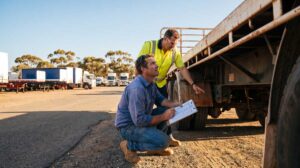
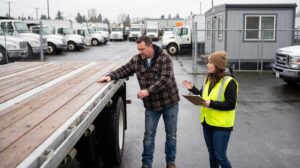
Heavy haulage in Australia is not for the faint-hearted. Whether you are moving excavators between mining sites in the Pilbara, transporting structural steel to a major construction project, or delivering oversized machinery to a remote agricultural property, the trailer you choose determines whether the job gets done safely and efficiently or whether it becomes an expensive, stressful problem.
Drop deck trailers have become one of the most important tools in the heavy haulage operator’s kit precisely because they solve a problem that flat decks cannot. They allow operators to carry tall, heavy loads while staying within height restrictions, and they make loading and unloading machinery far more practical on uneven or confined sites.
This article covers everything a serious operator needs to know about drop deck trailers for sale in Australia. We look at how they work, the configurations available, the legal landscape, what to look for when buying, and how they fit into a broader heavy haulage fleet.
What Is a Drop Deck Trailer?
A drop deck trailer, sometimes called a lowboy or step deck trailer, is a flatbed-style trailer engineered with two distinct deck levels. The front section, which connects to the prime mover via the fifth wheel, sits at a higher level. The main cargo deck drops down to a significantly lower ride height, allowing tall loads to clear overhead restrictions such as bridges, power lines, and tunnel height limits.
The drop in deck height between the front and main sections is achieved through a step or gooseneck arrangement at the front of the trailer. This design is what gives drop deck trailers their characteristic profile and their key advantage over standard flat top trailers.
In practical terms, a standard flat top trailer in Australia typically has a deck height of around 1,350 to 1,500 mm above the ground. A drop deck trailer can bring that down to 750 to 900 mm on the main deck, which translates directly into an additional 450 to 600 mm of usable load height before you reach the legal clearance limit. On a machine that is already close to the height limit, that difference is the margin between a standard road movement and an expensive, permit-heavy overdimensional load.
Why Drop Deck Trailers Are Essential for Heavy Haulage in Australia
Overcoming Australia’s Height Restrictions
In Australia, the standard maximum vehicle height for a general access vehicle is 4.3 metres, as set out by the National Heavy Vehicle Regulator (NHVR). This limit applies to the combined height of the vehicle and its load. When you are hauling machinery with a profile of 3.0 to 3.5 metres, the difference between a standard flat top and a drop deck trailer is the difference between staying within general access limits and needing a permit, pilot vehicles, and potentially route assessments.
For operators running regular machinery haulage routes, this distinction has a direct and significant impact on cost and scheduling. Permit movements require advance planning, route approvals, and sometimes curfew-restricted travel windows. Reducing the frequency of permit movements by using a drop deck trailer instead of a standard flat top can save substantial time and administrative overhead across a fleet.
Safer and More Practical Loading
The lower deck height of a drop deck trailer is not just about height clearances. It also makes loading and unloading machinery significantly safer and more practical. When a machine has to be driven or winched up onto a high flat deck, the ramp angle is steeper, the centre of gravity shifts more dramatically during the transition, and the risk of the load tipping or rolling back increases.
A drop deck trailer’s lower deck height reduces the ramp angle required to get machinery on board. For tracked excavators, skid steers, and other heavy plant, this is meaningful. It reduces wear on the machine during loading, reduces the risk of the undercarriage catching on the trailer edge, and makes the whole process more predictable and controllable for the operator on the ground.
Versatility Across Load Types
Drop deck trailers are not a niche tool. They are used across a remarkably wide range of heavy haulage applications in Australia, including:
● Construction plant and machinery: excavators, bulldozers, graders, compactors, and skid steers
● Agricultural equipment: headers, tractors, planting rigs, and large irrigation systems
● Mining equipment: drill rigs, processing components, and generator sets
● Structural steel and fabricated assemblies that exceed the height capacity of a flat top
● Prefabricated building modules, oversized concrete elements, and bridge components
● Industrial machinery including compressors, transformers, and process vessels
This versatility means that a quality drop deck trailer added to a heavy haulage fleet earns its keep across a wide variety of contracts, rather than sitting idle between specialised jobs.

Types of Drop Deck Trailers Available in Australia
Fixed Gooseneck Drop Deck
The fixed gooseneck is the most common configuration. The front section of the trailer is permanently attached to the main deck, and the load is driven or winched on via ramps at the rear. This is the most structurally rigid arrangement and is well suited to loads that can be loaded from the rear without requiring the gooseneck to be removed.
Fixed gooseneck drop decks are robust, relatively low maintenance, and available in a wide range of payload capacities. For most heavy plant haulage, this is the starting point.
Removable Gooseneck (RGN) Drop Deck
The removable gooseneck drop deck allows the front section to be detached from the main deck, effectively turning the trailer into a ramp from the front. This configuration is used when the load cannot be driven up from the rear, either because of its profile, its drive configuration, or the site conditions.
With the gooseneck removed, the main deck drops to ground level at the front, and the machine drives directly onto the trailer from the front. The gooseneck is then reattached for transport. RGN trailers are more expensive and require more careful operation, but they open up load types that are simply not manageable with a fixed gooseneck.
Extendable Drop Deck Trailer
Extendable drop deck trailers use a telescoping section in the main deck that allows the trailer length to be increased to accommodate longer loads. These are commonly used for structural steel, long pipe sections, wind turbine components, and other elongated loads that exceed standard trailer length.
When extended, these trailers almost always require permits for overdimensional length, but the alternative of using multiple trailers or custom fabricated transport frames is typically more expensive and more operationally complex.
Triaxle and Multi-Axle Drop Deck
For the heaviest loads, drop deck trailers are built with triaxle or multi-axle configurations that spread the gross mass across more axle groups, reducing the per-axle load to stay within legal limits. These trailers are commonly used in conjunction with a heavy-duty prime mover to move loads in the 50 to 100 tonne range. Understanding how next gen triaxle dollies for tough Australian work can be integrated into a drop deck configuration is worth exploring if you are working at the heavier end of the payload spectrum.
Drop Deck Trailer Configurations: A Comparison
The table below summarises the key differences between the main drop deck configurations to help narrow down the right choice for your operation.
| Configuration | Deck Height | Payload Range | Best For | Key Trade-off |
| Fixed Gooseneck | 750–900 mm | 20–60 t | General plant, machinery | Rear-load only |
| Removable Gooseneck | To ground level | 30–80 t | Front-loading machines, drill rigs | Higher cost, more complex ops |
| Extendable Deck | 750–900 mm | 20–50 t | Long structural loads, pipes | Requires length permit when extended |
| Triaxle / Multi-axle | 750–950 mm | 50–100+ t | Heavy mining, civil equipment | Higher tare weight, permit-heavy |
| Widener Drop Deck | 750–900 mm | 20–60 t | Wide plant, agricultural headers | Width permit required when expanded |
Note: deck heights and payload ranges are approximate and vary between manufacturers and configurations. Always verify the trailer’s rated capacity and confirm permit requirements with your state road authority before moving.
Legal Requirements for Heavy Haulage in Australia
Operating a drop deck trailer in Australia means operating within the National Heavy Vehicle Law, which is administered nationally by the NHVR and applies in every state and territory except Western Australia and the Northern Territory, which have their own equivalent frameworks. The NHVR’s Heavy Vehicle National Law overview is the primary reference for understanding your obligations as an operator.
General Access vs. Permit Movements
The critical distinction in heavy haulage is between general access movements, which comply with standard mass and dimension limits and require no special permit, and permit movements, which exceed one or more of those limits and require prior approval from the NHVR or the relevant state authority.
A drop deck trailer helps operators stay within general access limits more often than a standard flat top would, primarily by reducing load height. However, if your load exceeds the legal width (2.5 metres), height (4.3 metres), length, or mass limits even on a drop deck, you will still need a permit. The key numbers to know are:
● Maximum height: 4.3 metres (general access)
● Maximum width: 2.5 metres (general access); 3.5 metres with an overwidth permit in most states
● Maximum length: varies by configuration, typically 19 metres for a standard semi-trailer combination
● Maximum gross combination mass: varies by road type and axle configuration
Chain of Responsibility
Under the Heavy Vehicle National Law, all parties in the transport chain share responsibility for ensuring loads are safe and legal. This includes the operator, the consignor, the loader, and the consignee. If a load is incorrectly specified and a vehicle is found to be overloaded or overdimensional, the liability does not rest solely with the driver. Business owners, fleet managers, and logistics coordinators need to understand their obligations under Chain of Responsibility provisions.
For drop deck trailer operators, this means ensuring that load dimensions and weights are accurately assessed before dispatch, that permits are in place for any movements that require them, and that loads are properly restrained for transport.
Matching Your Drop Deck Trailer to the Right Prime Mover
A drop deck trailer is only as effective as the prime mover pulling it. For serious heavy haulage work, the prime mover needs to match the payload requirements, the terrain, and the operational demands of the routes you run.
The Kenworth K200 prime mover for heavy haulage is a proven option in the Australian market, offering a combination of engine power, chassis strength, and driver comfort that suits demanding haulage schedules. When matching a prime mover to a drop deck trailer, key considerations include the fifth wheel rating and its compatibility with the trailer’s kingpin load, the GCM rating of the prime mover relative to your expected gross combination mass, and whether the prime mover’s wheelbase and turning radius work with the trailer’s length in your typical operating environments.
Do not overlook the importance of the fifth wheel height in the prime mover. A fifth wheel height that is mismatched to the trailer’s kingpin height can cause the trailer to run with an unlevel deck, which affects load stability and can put uneven stress on the trailer structure over time.
What to Look for When Buying a Drop Deck Trailer for Sale in Australia
Structural Integrity and Weld Quality
The main deck structure of a drop deck trailer takes enormous stress, particularly at the step transition point where the deck changes height. This is the area most prone to fatigue cracking on older or heavily worked trailers. When inspecting a unit, look carefully at the weld quality and the condition of the steel at and immediately below the step.
Any cracking, previous repair welds, or visible deformation in this area should be treated as a serious concern. A qualified engineer should assess any cracking before purchase to determine whether the trailer is repairable to the required standard or whether the structural integrity is permanently compromised.
Deck Condition and Wear
The deck surface takes constant abuse from machinery tracks, loading equipment, and the loads themselves. Inspect the deck planking or plating carefully for:
● Worn or cracked timber planks that need replacement
● Steel plating that has worn thin, particularly in high-traffic areas near the rear ramps
● Loose, missing, or corroded deck fasteners
● Any deformation or dishing of the deck surface that suggests the trailer has been overloaded
Ramp Condition and Operation
The rear ramps are one of the highest-wear components on a drop deck trailer. They are repeatedly loaded and unloaded, often on uneven ground, and they take significant impact loads from machinery driving on and off. Check:
● That the ramps extend and retract smoothly without binding
● The hinge pins and ramp locking mechanism for wear and slop
● The ramp surface for wear, cracking, or damage to the cleating that provides traction
● Whether the ramps are hydraulically operated and if so, the condition of the cylinders and seals
Axles, Brakes, and Running Gear
Inspect the axles for any signs of overload damage such as bent axle tubes or damaged bearing housings. Check the brake drums or discs for wear and the brake adjustment for correct operation. In Australia, heavy vehicles must comply with the brake performance standards set out in the Australian Design Rules, and a trailer with worn or out-of-adjustment brakes is both illegal and dangerous.
Check the suspension for worn bushes, cracked spring leaves, and loose U-bolts. Air suspension systems should hold their set height without significant leakage. Check all air lines and valves for cracking or perishing.
Legal Compliance Documentation
When purchasing a drop deck trailer, always request and verify the following:
1. Current registration papers and compliance plate details
2. Engineer’s certificate for any modifications made to the original specification
3. Maintenance and service records for the last two to three years
4. Confirmation that the rated payload capacity matches your intended use
5. Details of any outstanding defect notices or safety recalls
New Versus Used Drop Deck Trailers: Weighing Up the Decision
The used drop deck trailer market in Australia is active and offers genuine value for operators who know what to look for. A well-maintained unit from a reputable fleet, with documented service history and no structural concerns, can represent excellent value compared to the cost of a new equivalent.
Before committing to any purchase, it is worth getting a clear picture of what you are looking at in terms of total cost of ownership. The resource on trailer pricing in Australia gives a useful overview of pricing across different trailer categories, which is a helpful starting point for calibrating expectations before you begin negotiations.
For new trailers, the main advantages are a clean history, manufacturer warranty, and access to the latest design features such as improved deck steels, better ramp systems, and integrated tie-down arrangements. The cost is significantly higher, but for operators who plan to run the trailer hard and need maximum reliability and a known maintenance baseline, the premium is justifiable.
For used trailers, the key is buying from a source where the history is documented. Fleet disposal sales, reputable equipment dealers, and engineering companies upgrading their plant are generally better sources than private sales with minimal documentation.
Integrating a Drop Deck Trailer Into Your Heavy Haulage Fleet
A drop deck trailer does not replace your other trailer types. It complements them. In a well-structured heavy haulage fleet, drop deck trailers handle the tall, heavy machinery loads that flat tops and curtainsiders cannot manage, while flat decks and other trailer types continue to handle the loads they are best suited to.
For operations moving the heaviest loads, combining a drop deck trailer with purpose-built support equipment is often the most efficient approach. A Freightwest bogie tag machinery trailer is an example of purpose-built Australian heavy haulage equipment designed to handle the demands that standard trailers simply cannot meet. Understanding how specialised trailers like this work alongside drop decks helps fleet managers build a configuration that covers the full range of their clients’ haulage needs.
Consider also the driver competency and training requirements for your fleet. Drop deck trailers, particularly removable gooseneck configurations, require skilled operators who understand load placement, weight distribution, and the mechanics of front-loading a machine safely. Investing in proper operator training reduces the risk of load incidents, protects your equipment, and keeps your operation compliant.
Keeping Your Drop Deck Trailer in Top Condition
Drop deck trailers require consistent, systematic maintenance to remain safe and productive. The following items should be part of your regular inspection and service schedule:
● Structural inspection at the step transition point every quarter, looking for hairline cracking in the welds and the surrounding steel
● Deck plank or plate inspection at every service, with immediate replacement of damaged or worn sections
● Ramp hinge pins and locking mechanisms greased and inspected at every pre-departure check
● Hydraulic ramp systems inspected for fluid level, cylinder condition, and seal integrity every service
● Suspension components checked for wear, cracking, and correct torque on all fasteners
● Brakes adjusted and inspected in accordance with the heavy vehicle maintenance schedule required under the NHVR’s Maintenance Management Framework
● All tie-down points and D-rings checked for deformation, cracking, and secure attachment to the deck structure
● Lighting, reflectors, and electrical connections checked at every pre-departure inspection
Keeping a documented maintenance log for each trailer in your fleet is not just good practice. Under the Chain of Responsibility provisions in the Heavy Vehicle National Law, it is part of demonstrating that your operation is being managed safely and responsibly.
Final Thoughts
Drop deck trailers are one of the most versatile and operationally important pieces of equipment in the Australian heavy haulage industry. Their ability to reduce effective load height, simplify the loading of tall and heavy machinery, and keep operators within general access limits more often than alternative trailer types makes them a genuine asset in any serious haulage fleet.
Whether you are looking at a fixed gooseneck unit for general plant haulage, a removable gooseneck for specialised front-loading applications, or an extendable configuration for structural and long-load work, the key is to match the trailer specification precisely to the work you need to do. Buying the wrong configuration, or a used unit without adequate inspection, is an expensive mistake in a segment of the market where quality and compliance are non-negotiable.
Take the time to assess your load types, your routes, your legal obligations, and your maintenance capacity before you commit to a purchase. The right drop deck trailer, properly specified and well maintained, will pay its way in your operation for many years.