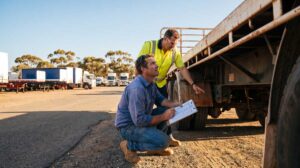
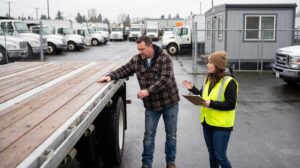
There is a reason the flat top trailer has never gone out of fashion in Australia. While every other trailer type has its niche, the flat top is genuinely universal. It can haul structural steel, precast concrete panels, heavy plant, agricultural machinery, pipeline sections, and a hundred other things besides, all from the same open platform that has been the backbone of Australian freight since roads were first pushed into the bush.
But universal does not mean interchangeable. If you are in the market for a flat top trailer for sale, the choices in front of you matter more than they might first appear. The difference between the right flat top and the wrong one shows up in your legal payload, your access to job sites, your fuel costs, your maintenance bill, and ultimately your profitability over the life of the asset.
This guide walks through everything you need to know to make a well-informed decision. We cover the configurations on offer, the specifications that matter, the legal framework that governs what you can carry and where, what to look for when inspecting a unit, and how to fit a flat top trailer into the broader needs of your fleet.
What Is a Flat Top Trailer?
A flat top trailer is a semi-trailer or drawbar trailer with an open, level load deck and no fixed sides, roof, or end walls. Loads sit directly on the deck surface, are positioned using the full available width and length of the platform, and are secured by chains, straps, and anchor points built into the deck structure.
The defining characteristic of a flat top is its deck height consistency. Unlike a drop deck or step deck trailer, where the load platform changes height along the length of the trailer, a flat top maintains a single, level deck from the headboard to the rear. This makes it the natural choice for loads that need a long, uninterrupted platform and for operations where loading and unloading are done by crane, forklift, or side loader rather than by driving machinery on and off.
In everyday Australian transport, the flat top trailer is one of the most common configurations on the road. From regional construction supply chains to mining site logistics, the sight of a prime mover pulling a loaded flat top is a constant of the Australian working landscape.
Flat Top Trailer Configurations: What Is Available
Standard Semi-Trailer Flat Top
The standard semi-trailer flat top is the most widely used configuration in Australia. It connects to a prime mover via a fifth wheel coupling, has a deck height typically between 1,350 and 1,500 mm above the ground, and is available in lengths from around 12 metres up to the maximum legal length for a single semi-trailer combination.
This is the configuration that covers the majority of heavy freight tasks where loads are crane-loaded, forklift-loaded, or placed from the side. Structural steel, concrete products, fabricated components, machinery, and bulk packaged goods all move regularly on standard flat top semi-trailers. If there is a general-purpose workhorse in the flat top category, this is it.
Triaxle Flat Top Trailer
Adding a third axle to a flat top semi-trailer distributes the gross mass across more axle groups, which increases the legal payload capacity under standard mass limits and often improves access to roads where individual axle group limits are more restrictive than the gross combination mass limit. Triaxle flat tops are the preferred choice for operations carrying consistently heavy loads such as large structural steel assemblies, heavy precast elements, or oversized machinery components. Learning how Freightwest triaxle built for Australian conditions are engineered for the specific demands of Australian roads and loads gives useful context for what to look for in a quality triaxle flat top.
B-Double Flat Top Combination
B-double combinations pair two flat top trailers in a configuration that can achieve a gross combination mass of up to 62.5 tonnes under standard conditions, with even higher payloads available under Performance-Based Standards (PBS) approvals. B-doubles require compliance with specific route and access requirements, and drivers need a B-double endorsement on their licence.
For high-volume freight operations on approved routes, a B-double flat top combination dramatically improves the payload per trip, reducing the number of movements required and lowering the per-tonne transport cost. The capital investment is higher, but the economics on the right routes are compelling.
Road Train Flat Top
In the outback and in the remote resource sector, road trains pulling multiple flat top trailers are a practical necessity. Routes that would require dozens of standard semi-trailer trips can be covered in far fewer movements with a properly permitted road train. Road train operations are subject to specific route approvals, access conditions, and driver licence requirements, but for the operations that use them, they are irreplaceable.
Extendable Flat Top Trailer
For loads that exceed standard trailer lengths, extendable flat top trailers use a telescoping deck that allows the overall length to be increased, sometimes by several metres. Wind turbine components, long structural steel members, and bridge elements all move on extendable flat tops. These trailers almost always require a special purpose vehicle permit when operated in the extended position, along with route pre-approval and often pilot vehicles.
Tag Trailer Flat Top
Tag trailers are a smaller flat top configuration towed behind a rigid truck rather than a prime mover. They are popular in construction, earthmoving, and agricultural operations where loads are moderate in size and the operator needs the flexibility of a truck-and-trailer combination that can access tighter sites than a full semi-trailer rig. The Freightwest bogie tag machinery trailer is a good example of purpose-built Australian tag trailer engineering designed for the machinery haulage segment.
Flat Top Trailer Configurations: Key Specs at a Glance
The table below provides a snapshot of the most common flat top trailer configurations used in Australia, with typical specifications and applications. Always verify manufacturer specifications and confirm legal requirements with your state road authority or the NHVR before purchase.
| Configuration | Deck Length | Deck Height | Approx. Payload | Best Application |
| Standard Semi Flat Top | 12–14 m | 1,350–1,500 mm | 20–26 t | General construction, steel, precast |
| Triaxle Flat Top | 12–14 m | 1,350–1,500 mm | 26–30 t | Heavy loads, large precast, plant |
| B-Double Flat Top | ~26 m (two) | 1,350–1,500 mm | 42–50 t combined | High-volume freight on approved routes |
| Road Train Flat Top | Varies | 1,350–1,500 mm | 50 t+ combined | Remote resource haulage, outback freight |
| Extendable Flat Top | Up to 22+ m | 1,350–1,500 mm | 20–28 t | Long structural loads, wind turbine components |
| Tag Trailer Flat Top | 4–9 m | 900–1,100 mm | Up to 12 t | Machinery, plant, construction equipment |
Payload figures are approximate and depend on tare weight, axle configuration, road type, and permit conditions. Confirm legal load limits with the NHVR or your state road authority before dispatch.
What to Look for When Shopping for a Flat Top Trailer for Sale
Whether you are buying new or used, the evaluation process for a flat top trailer should go well beyond the asking price and the deck length. Here is what matters most.
Main Frame Construction and Steel Grade
The main longitudinal rails are the structural backbone of a flat top trailer. They carry the bending loads imposed by heavy freight, the dynamic loads from road vibration, and the concentrated forces at crane and forklift pick-up points. The steel grade used in the main rails determines how heavy those rails need to be to do the job, which directly affects the tare weight of the trailer and therefore the legal payload.
Quality Australian-built flat top trailers use high-tensile steel in the main frame, typically with a yield strength of 700 MPa or better. This allows the rail sections to be lighter than equivalent low-strength steel members while maintaining or exceeding the required structural performance. When evaluating any flat top trailer, ask specifically about the steel specification in the main frame. A vague answer is a warning sign.
Inspect welds at all key joints, particularly at the rear crossmember, at any gooseneck or kingpin assembly, and at any point where the trailer has been modified or repaired. Cracking at weld toes, evidence of previous repair welds, or deformation in the rail sections are all serious concerns that warrant a professional engineering assessment before purchase.
Deck Surface and Condition
Flat top trailer decks come in two main surface types: hardwood timber plank and steel checker plate. Each has its advocates.
Hardwood timber planks are traditional and remain popular for their grip, their repairability, and the way they allow load restraint chains and straps to be positioned with flexibility along the deck length. Damaged planks can be replaced individually without major cost. The downside is that timber absorbs moisture, which can accelerate corrosion in the crossmembers beneath if drainage is inadequate.
Steel checker plate decks are more common on newer trailers and offer better durability in abrasive environments where loads are regularly slid or dragged across the surface. They are heavier than timber decks of equivalent strength, which marginally reduces payload capacity. They are also harder to repair cheaply if the plate is significantly damaged.
On a used trailer, inspect the deck surface carefully for:
● Worn-through areas in the timber or thinned areas in the plate, particularly under common load positions
● Cracked or split planks, delaminated timber, or rotted sections near the edges and at fastener holes
● Loose, missing, or corroded deck fasteners
● Any deformation or waviness in the deck surface that suggests the underlying crossmembers have been overloaded or damaged
Headboard Strength and Attachment
The headboard at the front of the trailer is the primary forward restraint barrier for loads that are not individually secured to resist forward movement by chains or straps. It needs to be properly engineered, properly attached to the main frame, and undamaged.
Check the headboard for any visible distortion, cracking at the welds where it attaches to the main frame rails, and any evidence of repair welding that might indicate a previous impact. A headboard that has been bent back and straightened, or that has repair welds at its base, should be assessed by an engineer before you rely on it for load restraint.
Anchor Points and Load Restraint Hardware
On a flat top trailer, every load must be secured by the operator before transport. The quality, capacity, and condition of the anchor points determine what loads can be legally restrained on that trailer. Standards in Australia require that anchor points meet the performance requirements of the Load Restraint Guide, which means they need to be rated to withstand the forces imposed by the loads they are expected to secure.
Check every D-ring, recessed pocket, and side rail anchor point for:
● Deformation, bending, or cracking in the anchor body or its attachment welds
● Visible wear at the contact surfaces where chains or hooks engage
● Loose or missing fasteners on bolted-on anchor points
● Whether the working load limit is stamped or marked on the fitting
Replace any anchor point that is damaged, deformed, or of unknown rating before the trailer goes to work. Running with compromised anchor points is both dangerous and a potential Chain of Responsibility liability.
Running Gear: Axles, Suspension, and Brakes
The axles, suspension, and brakes on a flat top trailer determine its safety, its road performance, and its maintenance cost over its working life. These are not areas to gloss over in an inspection.
Check axle tubes for any sign of bending, cracking, or impact damage. Bent axle tubes are a serious structural defect. Inspect bearing housings for damage and check wheel bearings for play by attempting to rock each wheel radially and axially.
Suspension inspection depends on the type fitted. For leaf spring suspension, check all spring leaves for cracking, check the shackle pins and bushes for wear, and check that all U-bolts are tight and undamaged. For air suspension, check air bags for perishing or damage, check air lines for cracking, and check that the trailer holds its set ride height without significant air loss over a few minutes with the system isolated.
Brake inspection on a heavy trailer is not something that should be rushed. Check drum or disc condition for wear and check brake adjustment on each axle. Uneven brake adjustment is a common problem on used trailers and creates uneven braking forces that can contribute to trailer instability under heavy braking. If the trailer has ABS, verify that the system is functional.
Coupling and Fifth Wheel Arrangement
The kingpin is the primary connection between the trailer and the prime mover. Check for wear by observing the kingpin closely when it is coupled and uncoupled. A worn kingpin will show visible slop in the fifth wheel, and the contact surfaces will show polishing or grooving that indicates excessive wear. Kingpin replacement is manageable if needed, but it adds to the cost of a used trailer purchase.
Check the turntable and any secondary coupling components for condition and lubrication. A dry or contaminated turntable wears rapidly and creates handling problems in the prime mover.
Registration, Compliance, and Documentation
Before you commit to any flat top trailer purchase, obtain and verify the following:
1. Current registration papers confirming the trailer’s legal status on Australian roads
2. The compliance plate, which should show the trailer’s rated GVM and any applicable mass limits
3. Engineer’s certificates for any modifications made after original manufacture
4. Service and maintenance records for the past two to three years
5. Details of any outstanding defect notices, safety recalls, or known issues
A trailer without documentation is always a risk. The absence of records does not mean the trailer has been badly maintained, but it does mean you cannot verify that it has been properly maintained. Price that uncertainty into your offer or walk away.

Legal Requirements for Flat Top Trailer Operations in Australia
Flat top trailer operations in Australia are governed by the Heavy Vehicle National Law (HVNL), administered nationally by the National Heavy Vehicle Regulator (NHVR). Western Australia and the Northern Territory maintain their own equivalent legislative frameworks, but the practical requirements are similar. Knowing your legal obligations before you put a trailer to work is not optional. It is a fundamental part of operating responsibly and commercially.
General Access Mass and Dimension Limits
For most flat top trailer operations, the key general access limits are:
● Maximum vehicle height: 4.3 metres (combined height of vehicle and load)
● Maximum vehicle width: 2.5 metres
● Maximum semi-trailer length: 19 metres for a prime mover and semi-trailer combination
● Maximum gross combination mass: determined by the axle configuration and road classification
Movements that exceed these limits require a permit from the NHVR or the relevant state authority. Permits introduce additional complexity, cost, and scheduling constraints. Where possible, choosing a trailer configuration and managing loads to stay within general access limits reduces your operational burden significantly.
Load Restraint Obligations
The Load Restraint Guide (2nd edition), published by the NHVR and the National Transport Commission, sets out the performance standards that load restraint systems must meet on Australian roads. Under these standards, loads must be restrained to withstand forces of 0.8g forward, 0.5g rearward, and 0.5g laterally and vertically. These are minimum performance standards, not targets, and they apply regardless of the type of load or the distance being travelled.
For flat top trailer operators, load restraint is the most operationally significant legal obligation on a day-to-day basis. Every load is different, every flat top is different, and the responsibility for ensuring the restraint system meets the legal standard on every trip sits with the driver, the loader, and under Chain of Responsibility provisions, potentially with the consignor and the operator as well.
Chain of Responsibility
The Chain of Responsibility provisions in the HVNL mean that safety obligations extend beyond the driver to everyone in the supply chain who has influence over transport decisions. If a load is inadequately restrained, the driver is not the only person who can face legal consequences. Fleet managers, schedulers, loaders, and business owners all have obligations they must actively discharge.
Maintaining clear documentation of load weights, load types, restraint methods used, and pre-departure checks is the most practical way for businesses to demonstrate compliance with their Chain of Responsibility obligations.
Flat Top Trailer Pricing in Australia
Flat top trailer prices in Australia vary widely depending on configuration, build quality, age, condition, and the current state of the used equipment market. Getting a realistic picture of how much flat top trailers cost before you begin shopping is time well spent. It calibrates your expectations, helps you identify when an asking price is realistic and when it is not, and gives you a foundation for negotiating with confidence.
New Flat Top Trailers
A new flat top semi-trailer from a reputable Australian manufacturer typically ranges from around $60,000 to $120,000 or more, depending on the specification, axle configuration, deck material, and any optional features such as air suspension, load-sensing brakes, or integrated load restraint systems. Triaxle units and extendable configurations add further to the cost.
The case for buying new is straightforward: a clean history, a manufacturer warranty, and the ability to specify the trailer exactly to your operational requirements. For fleet operators who intend to run the trailer continuously on demanding work, the higher initial cost is often justified by the reduction in early maintenance costs and the certainty of a documented starting point.
Used Flat Top Trailers
The used flat top trailer market in Australia is well supplied, and genuine value is available for buyers who approach the market with proper due diligence. A well-maintained flat top from a reputable fleet operator, with documented service records and no structural concerns, can offer significantly better value per dollar than a new equivalent.
If you are considering a used triaxle flat top as part of your evaluation, the used triaxle trailer buying guide covers the practical considerations in detail and is worth reading before you start inspecting units. Knowing what makes a used triaxle a sound investment, and what red flags to watch for, applies broadly to the flat top trailer category as a whole.
Price a used flat top trailer against the cost of the repairs or refurbishment it needs, not just against the asking price. A cheap trailer that needs a new deck, reconditioned brakes, and suspension work can quickly cost as much as a better-maintained unit that was priced higher to begin with.
Fitting a Flat Top Trailer Into Your Fleet
A flat top trailer does not exist in isolation. It works alongside your prime movers, your other trailer types, your loading equipment, and your customers’ site constraints. Getting the flat top right means thinking about how it integrates into that system, not just whether it can carry your loads in principle.
Matching the Trailer to Your Prime Mover
Fifth wheel height, GCM rating, wheelbase, and turning radius all interact between the prime mover and the trailer. A flat top trailer that is correctly specified but mismatched to your prime mover creates problems that show up every day on every job. Before you finalise a trailer purchase, confirm that the kingpin and fifth wheel are compatible, that the GCM rating of the prime mover is sufficient for the loaded trailer, and that the combination manoeuvres acceptably for the job sites you work on.
Loading Equipment and Site Access
A flat top trailer’s usefulness is partly a function of what you have available to load it. Crane-loading, forklift-loading, and side-loader operations all work well with a flat top deck. What does not work is expecting a load to somehow get onto a 1,400 mm high flat deck on a site that has no suitable loading equipment. Think through your loading and unloading process for each load type before you commit to a configuration.
Similarly, site access matters. A standard semi-trailer combination is around 19 metres long and has a turning radius that requires reasonable space. If your typical job sites are tight, a shorter combination or a tag trailer configuration might be more practical than the highest-capacity option.
Complementary Trailer Types
Most serious heavy freight fleets use flat tops alongside other trailer types to cover different load categories. Drop decks handle tall or heavy machinery that exceeds height limits on a flat top. Curtainsiders handle palletised freight that needs weather protection. Flat tops handle everything in between that needs an open platform and load flexibility.
Learn how each trailer type in your fleet complements the others helps you avoid over-investing in any single configuration and ensures you have the right tool for each job category you take on.
Maintaining Your Flat Top Trailer for the Long Haul
Flat top trailers are not particularly complex to maintain, but they do need consistent attention to stay safe, legal, and productive. The following items should form the core of your scheduled maintenance programme:
● Structural inspection: check main frame rails, crossmembers, and all welds at every quarterly service, with closer attention after any overload incident or heavy impact
● Deck surface: inspect timber planks for cracking, rotting, or wear-through at every service; replace damaged sections promptly to maintain a level, safe load surface
● Anchor points: inspect every D-ring, pocket, and side rail fitting for deformation, cracking, or wear at every service; replace before failure, not after
● Headboard: check attachment welds and structural integrity every quarter, particularly if the trailer regularly carries loads that press against the headboard in transit
● Kingpin and turntable: check kingpin wear and turntable lubrication at every service
● Suspension: check all leaf or air suspension components for wear, cracking, and correct torque on all fasteners at every service interval
● Brakes: adjust, inspect, and service brake systems in accordance with the NHVR’s Maintenance Management Framework requirements
● Lighting and electrical: inspect all lights, reflectors, and wiring at every pre-departure check and repair any defects before departure
Keeping a maintenance log for each trailer in your fleet is not optional if you want to demonstrate Chain of Responsibility compliance. It also protects your business in the event of an incident by providing documented evidence that the trailer was being maintained to the required standard.
Final Thoughts
The flat top trailer for sale market in Australia offers a wide range of options, from basic tag trailer configurations to sophisticated triaxle and B-double setups. Every configuration has its place, and the right choice depends entirely on the specifics of your operation: your loads, your routes, your legal obligations, your loading equipment, and your budget.
The most important thing you can do before committing to a purchase is to be clear about what you actually need. Too many operators buy the biggest, cheapest, or most immediately available trailer rather than the one that genuinely suits their work. The consequences show up in wasted payload capacity, access problems on job sites, higher-than-expected maintenance costs, and in some cases, compliance issues that create serious liability.
Take the time to define your requirements clearly, inspect any unit you are considering thoroughly, and do not underestimate the value of a professional engineering assessment on any used trailer where you have questions about its history or condition. A well-chosen flat top trailer, properly maintained and legally operated, will earn its place in your fleet for many years.