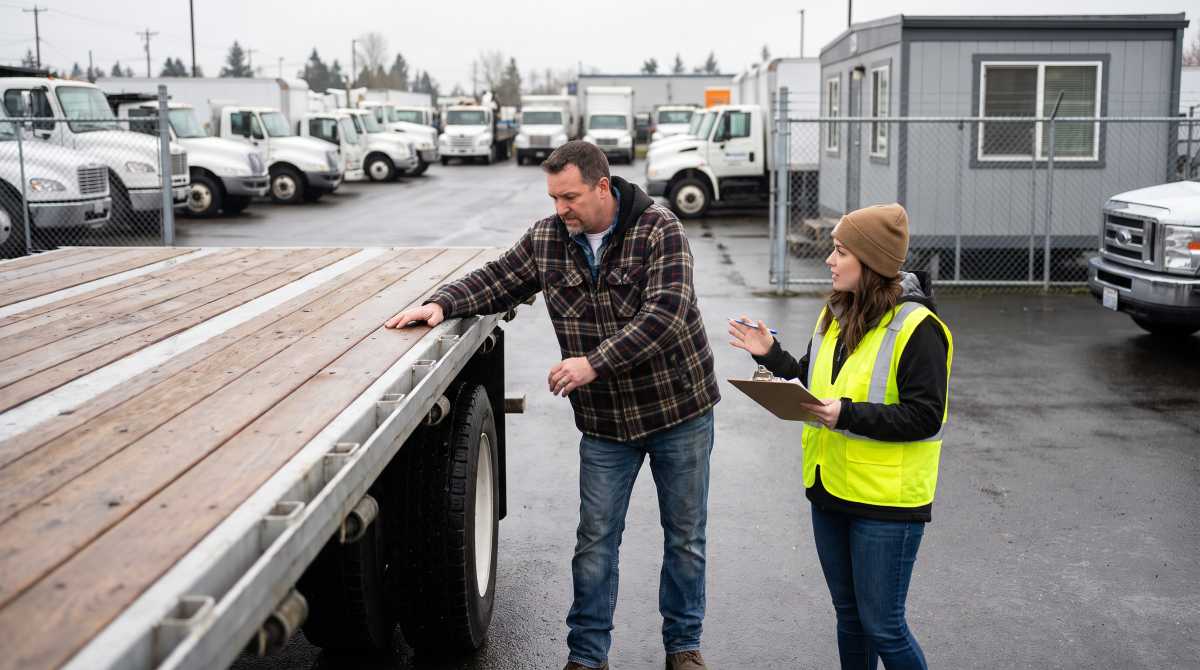
Ask any freight operator in Australia which trailer they would choose if they could only own one, and the answer is almost always the same. The flat deck. Not the curtainsider. Not the pantech. Not the drop deck. The flat top, with its unobstructed platform, its ability to accept loads from every direction, and its refusal to limit what you can carry based on the shape of the body around it.
There is a reason the flat deck truck trailer is the single most common semi-trailer configuration on Australian roads. It does not do one thing brilliantly. It does almost everything well enough. Steel beams on Monday. Precast panels on Tuesday. A 20-foot container on Wednesday. Timber packs on Thursday. A piece of machinery on Friday that no enclosed trailer could accept. This versatility is not a minor convenience. For operators running mixed freight businesses, taking ad hoc loads to fill gaps in the schedule, or serving industries where the cargo changes week to week, the flat deck is the trailer that keeps revenue flowing regardless of what the next job requires.
In 2026, new triaxle flat deck trailers start from approximately $65,000 for basic specifications and run to $100,000 or more for premium Australian-made units with airbag suspension, full gate sets, container pins, and road train plumbing. Used units range from $22,000 for older models to $70,000 for late-model, low-hour examples. These price points, combined with the flat deck’s unmatched versatility, make it the most cost-effective trailer investment for operators who need flexibility above all else.
This guide explains what makes the flat deck the default choice for general freight, how to specify one that matches your operation, what the key differences are between cheap and quality units, and how to avoid the specification mistakes that cost operators money for the life of the trailer.
Why the Flat Deck Truck Trailer Dominates General Freight
The flat deck’s dominance is not an accident. It is the result of a design philosophy that prioritises flexibility, simplicity, and payload efficiency in a way that no other trailer configuration can match.
Unrestricted Loading Access
The most fundamental advantage of a flat deck is that it has no sides, no roof, and no rear doors restricting how cargo is loaded. Freight can be placed from the left, the right, the rear, or from above by crane. This unrestricted access means the flat deck can handle loads that enclosed trailers simply cannot accept.
A curtainsider limits loading to the side and rear openings. A pantech limits loading to the rear doors. A tipper limits cargo to loose bulk materials. But a flat deck accepts:
- Structural steel loaded by overhead crane directly onto the deck
- Precast concrete panels stood upright in A-frames and secured with chains
- Shipping containers locked onto twist-lock pins flush with the deck surface
- Timber packs loaded by forklift from either side
- Oversized or irregularly shaped items that no enclosed body could accommodate
- Palletised freight loaded from any access point with a forklift
- Machinery and equipment driven or craned onto the deck for short relocations
This loading flexibility means the flat deck generates revenue from a wider range of freight types than any other single trailer, reducing the risk of empty runs and enabling operators to accept opportunistic loads that would be impossible with a more specialised configuration.
Simplicity and Reliability
A flat deck has no moving parts beyond the landing legs and the braking system. There are no curtain mechanisms to jam, no hydraulic tipping systems to maintain, no refrigeration units to service, and no doors or hinges to repair. This mechanical simplicity translates directly into lower maintenance costs, reduced downtime, and a longer operational life.
The most common maintenance items on a flat deck are tyres, brakes, suspension components, and periodic structural inspection. Compare this to a curtainsider that requires curtain replacement every few years, a tipper that needs hydraulic system servicing, or a reefer that demands compressor maintenance, and the flat deck’s whole-of-life maintenance advantage becomes clear.
Payload Efficiency
With no body panels, no roof structure, and no mechanisms adding weight, the flat deck achieves one of the lowest tare weights of any trailer configuration. A standard triaxle flat top weighs approximately 6.5 to 8 tonnes depending on specification and materials. An equivalent curtainsider weighs 8 to 10 tonnes. That two-tonne difference is two additional tonnes of payload on every trip, which over thousands of loads compounds into significant additional revenue.
For operators running at or near the legal mass limits on their routes, this payload advantage is the difference between profitability and marginal viability. Understanding how to match the right trailer to your business needs involves calculating exactly this balance between tare weight and earning capacity.
How to Specify a Flat Deck That Matches Your Operation
Not all flat decks are created equal, and the specifications you choose affect the trailer’s versatility, payload capacity, durability, and resale value. Here is what matters most.
Key Specification Comparison Table
| Specification | Standard Option | Premium Option | Impact |
| Deck length | 40 ft (12.2m) | 45 ft (13.7m) or 48 ft (14.6m) | Longer deck carries more pallets and longer loads |
| Deck material | Steel | Aluminium or hardwood timber | Aluminium saves 500-800kg tare weight |
| Suspension | Mechanical spring | Airbag with dump valve | Airbag gives better ride, adjustable height, lower tare |
| Axle configuration | Triaxle (3 axle) | Quad axle (4 axle) | Quad increases GVM but adds tare weight |
| Braking | Standard drum | EBS (Electronic Braking System) | EBS gives faster, more even braking response |
| Gates | Front headboard only | Full set (front, sides, rear) | Full gates improve load restraint versatility |
| Container pins | None | 3-way pins with pedestals | Enables container transport as well as general freight |
| King pin | Fixed single position | Two-position adjustable | Adjustable improves load distribution flexibility |
Deck Length and Configuration
The standard semi-trailer deck length in Australia is 40 feet (12.2 metres), which accommodates 20 standard pallets in a two-wide configuration. For operators who need additional capacity, 45-foot and 48-foot extended decks are available, carrying 22 to 24 pallets.
Longer decks are not always better. They increase the trailer’s swept path in tight turns, limit manoeuvrability on congested urban sites, and may require route assessment for access to specific delivery points. For metropolitan freight, the standard 40-foot deck often provides the best balance of capacity and manoeuvrability. For linehaul and regional work where tight access is less of a concern, the additional capacity of a longer deck improves revenue per trip.
Extendable flat decks, which telescope from standard length to 60 feet or more, are available for operators who need to carry extra-long loads such as bridge beams, wind turbine components, and long structural steel. These are specialised units that command a premium price.
Deck Material
The deck surface is where every load sits, and the material you choose affects tare weight, durability, and grip.
- Steel decks are the most durable and the most common. They resist impact damage, handle heavy point loads from machinery, and are easy to repair. The trade-off is weight.
- Aluminium decks save 500 to 800 kilograms compared to steel, which translates directly into additional payload. They are increasingly popular among operators who run at or near mass limits. The trade-off is lower resistance to impact damage and higher initial cost.
- Hardwood timber decks provide excellent grip for general freight and are the traditional choice for many applications. They are relatively lightweight and provide a forgiving surface that is less likely to damage cargo. The trade-off is susceptibility to moisture damage and a finite lifespan compared to metal decks.
Suspension
Suspension choice affects ride quality, load protection, tyre wear, deck height, and tare weight.
Airbag suspension is now the standard for most new flat decks. It provides a smoother ride that protects cargo, adjustable deck height via dump valves for easier loading, and typically lower tare weight than mechanical spring suspension. It also qualifies the trailer for concessional mass schemes on approved routes, which can add three to five tonnes of additional payload capacity.
Mechanical spring suspension is simpler, more robust in extreme conditions, and cheaper to maintain. It is still used in some heavy-duty mining and construction applications where the operating environment is too harsh for airbag systems.
For a comprehensive look at current pricing across all specifications, the guide to truck trailer costs in Australia breaks down what you can expect to pay for different configurations and conditions.
Gates and Load Restraint
Gates are not optional on a working flat deck. They are essential safety equipment that prevents loads from shifting off the deck during transit.
A full gate set includes a front headboard that prevents forward load movement under braking, side gates that contain the load laterally, and a rear gate or tailgate that prevents rearward movement. Gates are available in fixed, removable, and folding configurations. Removable gates provide maximum flexibility, allowing the deck to be configured differently for different load types.
Beyond gates, the number, position, and rating of tie-down points on the deck determine how effectively you can restrain different cargo types. Look for:
- Multiple rated anchor points along both rails and across the deck
- D-ring or swivel hook tie-downs rated for the loads you intend to carry
- Coaming rails that provide a continuous anchor line along the deck edges
- Rub rails that protect the deck edges from loading damage
Container Pins
If there is any possibility that your flat deck will carry shipping containers, specify container pins from the outset. Three-way container pins with pedestals allow the trailer to accept 20-foot and 40-foot containers in multiple positions on the deck, effectively giving you a skeletal trailer capability as well as a flat deck in a single unit.
Retrofitting container pins to a deck that was not designed for them is possible but more expensive and less structurally optimal than specifying them at build.
The Flat Deck vs Other Trailer Types
Understanding how the flat deck compares to alternative configurations helps you confirm that it is the right choice for your primary application and identify situations where a different trailer type might be worth adding to your fleet.
Flat Deck vs Curtainsider
| Factor | Flat Deck | Curtainsider |
| Loading access | All sides plus overhead | Sides and rear only |
| Weather protection | None (requires tarps) | Full enclosure |
| Tare weight | 6.5-8 tonnes | 8-10 tonnes |
| Cargo flexibility | Accepts any shape or size | Limited by body dimensions |
| Maintenance | Minimal | Curtain replacement, track maintenance |
| Typical use | Steel, timber, machinery, mixed | Palletised goods, retail delivery |
The curtainsider wins when weather protection and load security are priorities. The flat deck wins when loading flexibility, payload capacity, and cargo diversity are the driving factors.
Flat Deck vs Drop Deck
The drop deck provides a lower rear platform for carrying taller loads within height limits. It is the better choice for dedicated equipment transport work. But it carries a higher tare weight, costs more, and is less versatile for general freight than a flat deck. Operators who need both capabilities sometimes consider a widening drop deck that combines equipment-carrying capability with freight flexibility, though these are specialised units that come at a premium.
For a detailed guide to evaluating drop deck options, the drop deck buying guide covers the key specifications and considerations.
Flat Deck vs Tipper
These serve entirely different purposes. A tipper carries loose bulk materials and discharges them by raising the body. A flat deck carries unitised, palletised, or restrained loads on a fixed platform. There is no overlap between the two. Operators who need both typically own at least one of each. For guidance on specifying tippers for WA conditions, the side tipper selection guide covers what to look for.

Buying New vs Used Flat Decks
The new versus used decision for flat deck trailers follows the same logic as any trailer purchase, but with some flat-deck-specific considerations.
2026 Pricing Overview
| Condition | Price Range | What You Get |
| New (basic spec) | $65,000-$78,000 | Standard steel deck, mechanical or airbag suspension, headboard, basic tie-downs |
| New (premium spec) | $85,000-$100,000+ | Australian-made, full gate set, container pins, EBS, airbag, alloy wheels |
| Used (5-10 years old) | $30,000-$55,000 | Working condition, inspected, may need tyres or brake service |
| Used (10+ years old) | $22,000-$35,000 | Budget option, thorough inspection essential, may need significant servicing |
Why Used Flat Decks Hold Their Value
Flat decks depreciate more slowly than most other trailer types because their mechanical simplicity means there is less to wear out. A 10-year-old flat deck with a sound chassis, decent tyres, and working brakes is still a fully functional revenue-generating asset. This residual value makes flat decks one of the safest trailer investments from a depreciation perspective.
For operators evaluating used options, the pre-purchase checklist for WA trailer buyers covers the critical inspection points. Focus particularly on chassis cracking around axle mounts and coupling areas, deck surface condition and any evidence of welded repairs, suspension component wear including airbags, shocks, and bushings, brake pad thickness, drum condition, and air system integrity, tyre condition and age, and the condition of landing legs, king pin, and coupling hardware.
Buy vs Hire for Flat Decks
If your requirement is temporary, seasonal, or project-based, hiring a flat deck can be more cost-effective than purchasing. Hire rates for triaxle flat decks typically run $3,500 to $5,000 per month, which includes registration, insurance, and maintenance. If you need the trailer for less than 8 to 10 months of the year, hiring often delivers better value than owning.
Industries That Rely on the Flat Deck
The flat deck’s versatility makes it relevant across almost every industry that moves physical goods.
Construction and Building
Construction businesses use flat decks to deliver structural steel, precast concrete elements, timber framing, roofing materials, scaffolding, and formwork to building sites. The ability to load from any direction using crane, forklift, or hiab makes the flat deck indispensable on sites where loading equipment and access points vary from job to job.
Manufacturing and Industrial
Manufacturers use flat decks to transport finished goods, raw materials, machinery, and production equipment between factories, warehouses, and customer sites. The open deck accommodates the irregular shapes and sizes common in industrial freight without the dimensional constraints of enclosed bodies.
Agriculture
Flat decks carry hay bales, fencing materials, farm equipment, irrigation components, and bulk agricultural supplies across regional road networks. Their durability on unsealed roads and their tolerance for rough loading conditions make them well suited to agricultural applications.
Mining Support
The resources sector uses flat decks to transport pipe, structural steel, camp buildings, equipment skids, and general supplies between Perth and remote mine sites. The trailer must handle extreme heat, dust, and long distances on roads that range from sealed highway to corrugated gravel.
Freight and Logistics
General freight operators use flat decks as their baseline trailer for any load that does not require temperature control or weather protection. The flat deck fills gaps in the schedule, accepts overflow loads, and provides the flexibility to say yes to jobs that a more specialised trailer would have to decline.
Load Restraint on a Flat Deck
Because the flat deck has no enclosing body, the entire responsibility for load security falls on the operator’s restraint system. This is both a regulatory obligation and a safety imperative.
Key Load Restraint Principles
- Every load must be restrained to prevent movement in any direction, including forward under braking, rearward under acceleration, and laterally during cornering or evasive manoeuvres.
- Chains, straps, and ropes must be rated for the load they are securing. The combined rating of all restraints must equal or exceed the weight of the load in the forward direction and half the weight of the load in the rearward and lateral directions.
- Dunnage and friction mats increase the friction between the load and the deck, reducing the restraint force required and preventing load movement at the contact surface.
- Blocking and bracing uses physical barriers, such as gates, chocks, and timber, to prevent the load from sliding in specific directions.
- The Load Restraint Guide, published by the National Transport Commission, provides the definitive reference for load restraint requirements in Australia. Every operator running a flat deck should have a copy and ensure their drivers are trained in its application.
For operators with questions about load types, restraint methods, and flat deck operation, the truck trailer FAQ guide covers the most commonly asked questions.
Making Your Purchase Decision
The flat deck is the right choice for your operation if your freight mix includes multiple cargo types that change frequently. If your loading conditions vary between crane, forklift, and ground-level access. If payload capacity is critical to your margins. If you need a trailer that can double as a container carrier with the right pins. And if you want the lowest maintenance and longest service life of any trailer configuration.
It may not be the right choice if your primary cargo requires weather protection, if you exclusively carry loose bulk materials that need tipping capability, or if your loads consistently require the lower deck height that a drop deck provides.
For operators ready to explore what is available, the full range of trailers in stock provides an up-to-date view of flat decks, drop decks, tippers, and specialised configurations. And for a broader overview of all trailer categories, the complete trailer section covers every type available to Australian operators.
Frequently Asked Questions
What is the difference between a flat deck and a flat top trailer?
In Australia, the terms “flat deck” and “flat top” are used interchangeably to describe the same trailer type: an open, unobstructed platform trailer without sides, roof, or enclosure. Some manufacturers and operators prefer one term over the other, but they refer to identical equipment. The trailer features a flat loading surface, tie-down points for load restraint, and typically a front headboard. It is the most common semi-trailer configuration in Australia for general freight applications.
How much does a flat deck truck trailer cost in 2026?
New triaxle flat deck trailers range from approximately $65,000 for basic specifications to $100,000 or more for premium Australian-made units with airbag suspension, full gate sets, container pins, and EBS braking. Used flat decks range from $22,000 for older models to $55,000 to $70,000 for late-model, well-maintained examples. The price depends on the deck length, material, suspension type, axle configuration, and included features. Flat decks hold their value well compared to other trailer types due to their mechanical simplicity and broad market appeal.
What can you carry on a flat deck trailer?
A flat deck can carry virtually any freight that fits within the legal mass and dimension limits and can be adequately restrained. Common loads include structural steel, timber, building materials, precast concrete, shipping containers, palletised goods, machinery, pipe, fencing materials, hay bales, and oversized or irregularly shaped items. The open deck design means there are no body dimensions restricting what you can load, making the flat deck the most versatile trailer type available. All loads must be properly restrained using chains, straps, blocking, and bracing in accordance with the National Transport Commission’s Load Restraint Guide.
Is a flat deck better than a curtainsider for general freight?
It depends on your priorities. A flat deck offers superior loading access from all sides plus overhead, lower tare weight giving more payload capacity, and the ability to carry oversized or irregularly shaped loads. A curtainsider offers weather protection and improved security for the cargo. If your freight mix is diverse and includes heavy, oversized, or crane-loaded items, a flat deck is the more versatile choice. If your primary freight is palletised goods that need protection from rain and dust, a curtainsider may be more practical. Many operators own both types to cover different freight requirements.
How long does a flat deck trailer last?
A well-maintained flat deck trailer can provide 20 to 30 years of service. The mechanical simplicity of the design, with no moving body components, hydraulics, or refrigeration to maintain, contributes to this longevity. The chassis, deck, and structural components are the primary determinants of lifespan, and regular inspection for cracking, corrosion, and fatigue ensures problems are caught early. Suspension components, brakes, and tyres are consumable items that are replaced as part of normal maintenance. Flat decks depreciate more slowly than most other trailer types, making them one of the most financially durable trailer investments.