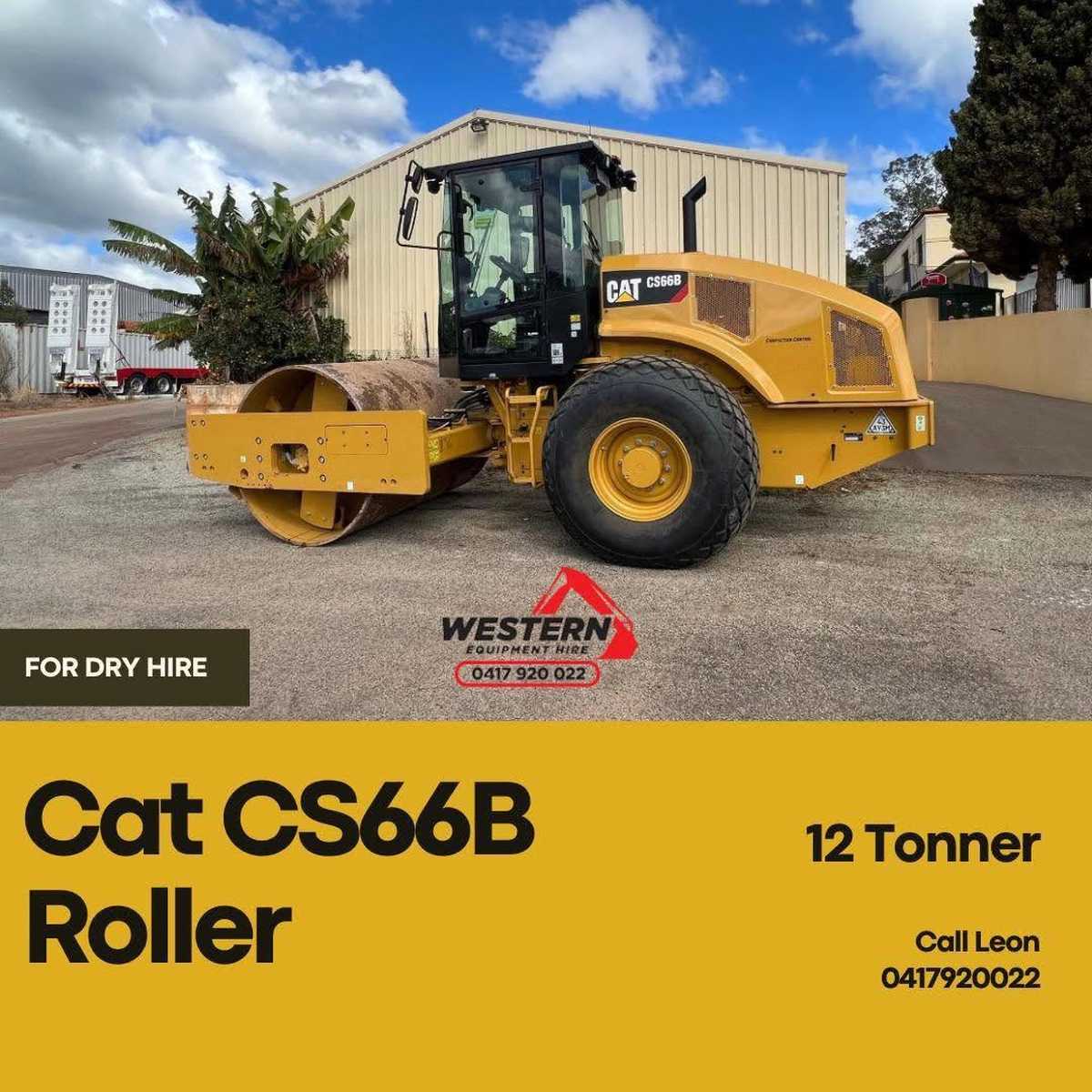
If you are involved in earthworks, civil construction, road building, or site preparation anywhere in Western Australia, the Cat CS66B roller is a machine you will encounter regularly. This 12-tonne smooth drum vibratory soil compactor has established itself as one of the most capable and reliable compaction machines in its class, earning a reputation across Perth job sites, regional infrastructure projects, and resource sector developments as the unit that consistently delivers target density without fuss.
Compaction is not glamorous work, but it is foundational. Every road, every building pad, every pipeline trench, and every dam wall depends on soil that has been compacted to specification. Get it wrong and you are dealing with settlement, cracking, structural failure, and costly remediation. Get it right and the work disappears beneath the surface, doing its job invisibly for decades. The Cat CS66B is built to get it right, efficiently and repeatedly, across the varied soil conditions and demanding environments that define construction in Western Australia.
This buyer’s guide breaks down everything you need to know about this machine before purchasing, including its key specifications, standout features, how it performs on WA sites, and the road conditions across Perth that make quality compaction equipment essential.
Cat CS66B Specifications and Performance Overview
The CS66B sits in the 12-tonne class, making it versatile enough for a wide range of applications while delivering the operating weight needed for effective compaction on granular soils, sand, gravel, and clay. Here are the core specifications that matter to operators and fleet managers.
- Operating Weight: 12,362 kg
- Engine: Cat C4.4 with ACERT technology
- Engine Power: 117 kW (157 hp)
- Drum Width: 2,134 mm (84 in)
- Drum Diameter: 1,534 mm (60.4 in)
- Drum Shell Thickness: 30 mm
- Overall Length: 5.86 m
- Overall Width: 2.30 m
- Overall Height: 3.11 m
- Maximum Travel Speed: 11.4 km/h
- Inside Turning Radius: 3.68 m
- Hitch Articulation Angle: 34 degrees
- Hitch Oscillation Angle: 15 degrees
The Cat C4.4 engine delivers strong, reliable power while meeting current emission standards. For operators managing fuel budgets across multiple machines on a large project, the efficiency of this engine translates directly into lower daily running costs.
Why the CS66B Stands Out From Other 12-Tonne Compactors
Several features distinguish the CS66B from competing machines in the same weight class.
Dual pump propel system. The CS66B uses an exclusive Cat dual pump propel system that provides separate, dedicated hydraulic flow to the drum drive motor and rear axle motor. This delivers exceptional gradeability and traction in both forward and reverse, which is critical on sloping sites, embankments, and uneven terrain common across WA construction projects.
Cat Compaction Control technology. The machine offers both accelerometer-based (CMV) and exclusive Machine Drive Power (MDP) measurement technologies. These systems provide real-time compaction data to the operator, helping determine when target density has been achieved. This reduces over-compaction, eliminates unnecessary passes, and provides documentation for quality assurance.
Auto-vibe function. The automatic vibration system works in tandem with the compaction control technology to deliver uniform compaction results. The system adjusts automatically, reducing operator fatigue and improving consistency across large compaction areas.
Rear vision camera. Visibility is a constant safety concern on busy construction sites. The integrated rear vision camera enhances the operator’s awareness of what is behind the machine, reducing the risk of incidents during reversing manoeuvres.
Operator comfort. Extended shifts are common on WA sites, particularly during the busy construction season when daylight hours are long and project deadlines are tight. The CS66B’s cab is designed for sustained comfort with good visibility, low noise levels, and intuitive controls that reduce operator fatigue over a full day’s work.
Optional levelling blade. For operators who need to spread and level material before compaction, the optional levelling blade extends the machine’s overall length to 6.4 m and width to 2.5 m, adding versatility without requiring a separate machine on site.
How the CS66B Performs Across WA Soil Types
Western Australia presents a diverse range of soil conditions that test any compaction machine. From the deep red pindan soils of the Kimberley to the sandy coastal formations around Perth, the limestone formations of the south-west, and the heavy clay subgrades found across the Wheatbelt, the CS66B is engineered to deliver results across this full spectrum.
The machine excels on:
- Granular soils including sands, gravels, and crushed rock, which are the most common fill materials on WA road and civil construction sites
- Clay and silt subgrades when fitted with the appropriate amplitude and frequency settings
- Rock fills on mining and resource infrastructure projects
- Mixed fills encountered during subdivision and land development work across Perth’s expanding urban fringe
The compaction control technology is particularly valuable in WA conditions, where soil variability within a single site can be significant. Rather than relying on fixed pass counts that may under-compact some areas and over-compact others, the operator can use real-time data to achieve specification across the entire work area.
Perth WA Road Conditions and Why Quality Compaction Matters
Perth’s road network is under constant pressure from urban growth, heavy vehicle traffic, and a climate that alternates between extreme heat and seasonal rainfall. Main Roads Western Australia manages state-controlled roads and publishes live conditions through its Travel Map, covering a range of statuses that directly affect how roads perform over time.
Common road condition categories across the Perth network include:
- Road Open / Open with Caution for routes with minor hazards such as wet or slippery surfaces or reduced visibility from fog
- Lane Closure / Detour in Place during active roadworks and construction zones
- Roadworks and Construction / Resurfacing and Maintenance covering the constant cycle of upgrades and repairs across Perth’s expanding road network
- Pavement Damage resulting from heavy vehicle loads, subgrade failure, or age-related deterioration
- Flooding and Water over Road during winter rainfall events, particularly in low-lying areas and near drainage infrastructure
- Corrugated and Loose Surface conditions common on unsealed roads in Perth’s outer suburbs and regional areas
- Restricted Access with vehicle type and weight limits on roads where pavement capacity is limited
- Smoke Hazard from bushfires and controlled burns, particularly during the summer months across Perth’s eastern fringe
- Livestock and Wildlife on Road / Debris on Road on semi-rural and regional routes
- High Wind Warning / Wet and Slippery Surface during seasonal weather events
- Traffic Signal Outage / Congested and Heavy Traffic in metropolitan areas during peak periods
- Verge Damage / Impassable on roads affected by severe weather or structural failure
Every one of these conditions traces back, in part, to the quality of the road’s foundation. Pavement damage, rutting, and premature failure are frequently linked to subgrade compaction that did not meet specification during construction. Machines like the CS66B, with their compaction measurement and documentation capabilities, help ensure that the foundation work is done properly, reducing the likelihood of costly road failures down the track.
For operators working on Perth’s major infrastructure projects, including highway upgrades, new subdivision developments, and the ongoing expansion of freight routes, the CS66B’s combination of productivity, precision, and documentation capability makes it a strong fit.
Buying a Cat CS66B in Western Australia
When purchasing a CS66B, whether new or used, consider the following factors.
- Hours and service history. For used machines, low hours with a documented service history from an authorised provider offer the best assurance of remaining useful life.
- Drum condition. Inspect the drum shell for wear, dents, and evenness. The 30 mm shell thickness provides good longevity, but heavily worked machines may show signs of wear.
- Vibration system condition. Test the vibratory mechanism across all settings. Any unusual noise or inconsistent vibration indicates potential bearing or eccentric weight issues.
- Tyre condition. Check the rear tyres for tread depth and sidewall damage. Replacement tyres for machines of this class are a significant expense.
- Technology packages. Confirm whether the machine includes compaction control technology, as not all units are identically equipped.
If you are looking for rollers currently available in WA, Western Truck Sales maintains an updated inventory of compaction equipment suited to Western Australian conditions. Their stock also extends to graders and skid steers for operators building out a complete earthmoving fleet.
For those also managing a trucking fleet alongside their earthmoving operations, their guides on why the Sitrak C7H tipper dominates WA job sites and the 2021 Actros 2663 road train opportunity are worth a read, along with practical advice on rookie truck driver mistakes to avoid and a look at Australia’s most iconic trucking routes.
Frequently Asked Questions
What weight class is the Cat CS66B roller?
The Cat CS66B has an operating weight of 12,362 kg, placing it firmly in the 12-tonne class. This makes it suitable for a wide range of compaction applications including road construction, subdivision development, pipeline backfill, and embankment work. The weight is optimised to achieve target density on granular soils efficiently while remaining transportable on a standard low-loader without requiring oversize permits in most configurations.
What type of soil is the CS66B best suited for?
The CS66B is ideally suited for granular soil applications including sand, gravel, crushed rock, and mixed fills. It also performs effectively on cohesive soils such as clay and silt when the amplitude and frequency settings are adjusted appropriately. For cohesive soil applications requiring a padfoot drum, the CS66B can be fitted with an optional padfoot shell kit to improve penetration and shearing action.
Does the Cat CS66B include compaction measurement technology?
Yes. The CS66B offers Cat Compaction Control technology, including accelerometer-based measurement (CMV) and the exclusive Machine Drive Power (MDP) system. These technologies provide real-time compaction data to the operator and can generate documentation for quality assurance purposes. However, the specific technology package may vary between individual machines, particularly on the used market, so confirm the included features before purchasing.
How does the CS66B handle slopes and uneven terrain?
The dual pump propel system provides separate hydraulic flow to the drum and rear axle, delivering strong traction and gradeability in both forward and reverse. The machine can handle slopes of up to 57 per cent theoretically without vibration. The 15-degree oscillation angle and 34-degree articulation angle provide stability and manoeuvrability on uneven ground, making it well-suited to the varied terrain encountered on WA construction sites.
What should I inspect when buying a used Cat CS66B?
Focus on the documented service history and total operating hours, the condition and thickness of the drum shell, the performance of the vibratory mechanism across all amplitude and frequency settings, rear tyre condition and tread depth, hydraulic system integrity including hoses, cylinders, and connections, and whether compaction control technology is fitted and functional. A pre-purchase inspection by a qualified heavy equipment mechanic is strongly recommended for any used machine purchase.
This guide is intended for informational purposes only. Equipment buyers should always seek independent professional advice regarding machine suitability, financing, and regulatory compliance before making a purchase decision.